Verified Local Contractors: What the Badge Actually Checks
What a verified badge means on a contractor profile: what it checks, what it leaves out, and how to check licenses and insurance yourself.
A small badge next to a contractor's name can feel like the whole answer. When you look for verified local contractors, you usually want three things at once: a real person or business, someone who actually works where you live, and someone qualified for the job in front of you. A verified badge on a contractor profile can settle the first. It rarely settles the other two on its own.
“Verified” is not a legal standard. Each website decides what it checks, and the same word can mean a confirmed email address on one site and a reviewed government ID on another. Knowing what sits behind the badge tells you which checks are already done and which ones are still yours before anyone starts work on your home. The rest of the process is in our step-by-step guide to hiring a contractor.
What “verified” can mean on a contractor profile
Verification usually covers one or more of these: an email address or phone number, a government photo ID, a business registration, a home or business address, a trade license, proof of insurance, or a background check. Some sites check a single item. Others check several, and some check different things for different kinds of businesses.
Before you rely on a mark, find the page that explains it. A trustworthy platform says plainly what was checked, who it applies to, and what it does not cover. If you cannot find that explanation, treat the badge as decoration and do your own checks.
Checks also age. A license can lapse and an insurance policy can end after a badge was first shown. A mark that says when something was checked, or shows its current status, is more useful than one that never changes.
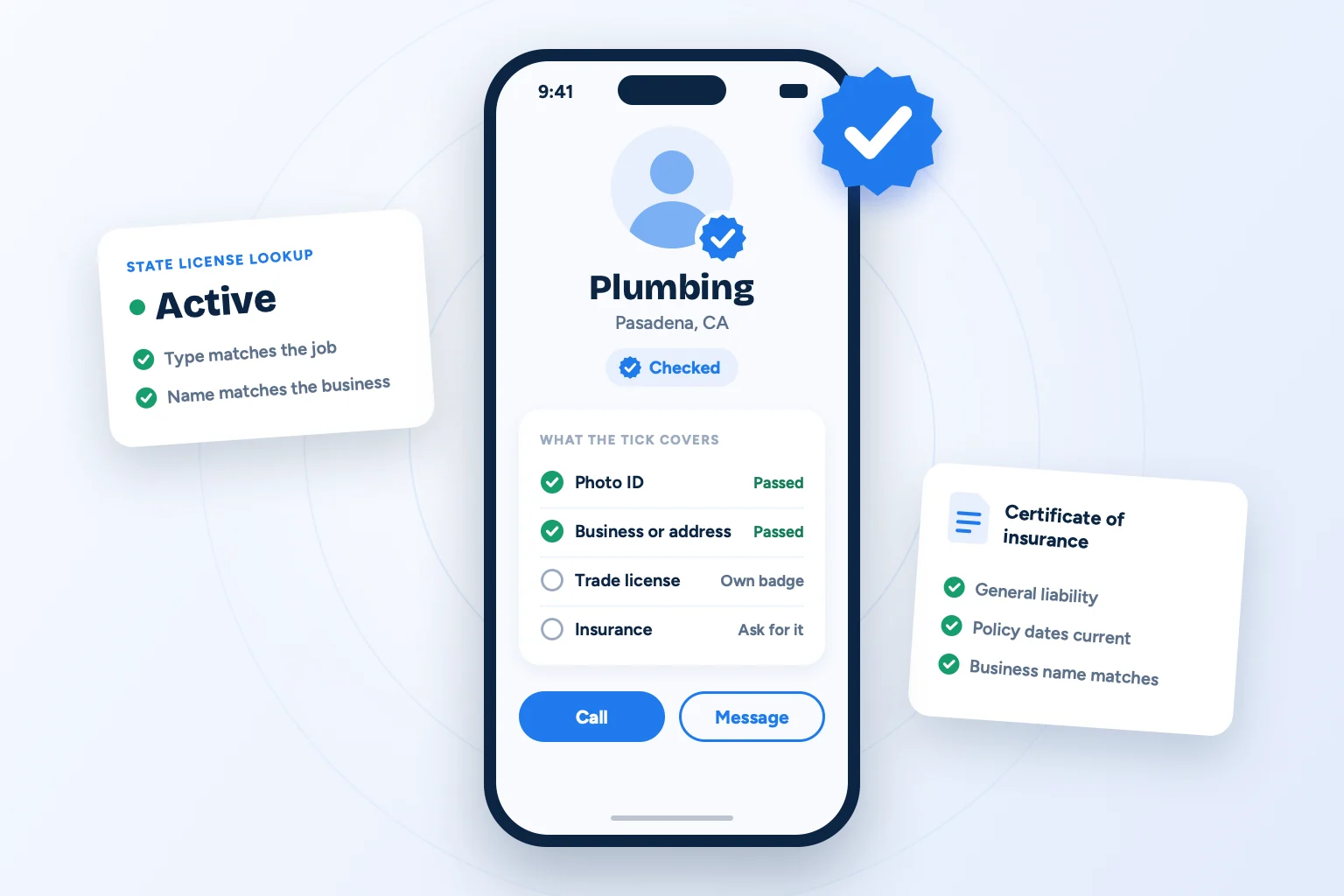
On Taskovery, the tick means one specific thing: every check the contractor's account requires has passed. That is a photo ID, plus a business registration check for a company or a proof of address for a sole trader. Until those pass, there is no tick, and the contractor cannot answer posted jobs at all. You can read exactly what the tick covers before you rely on it.
What a verified badge does not tell you
Identity checks answer one question: is this person who they say they are? They do not answer whether the work will be good. Nobody from a directory or marketplace has usually stood in a customer's kitchen and inspected the contractor's last job, and a responsible platform will tell you so.
A general verification mark also does not prove that someone holds the license your job needs. On Taskovery, a trade license is a separate, optional check with its own badge, so do not assume the main tick includes it. The tick is not a criminal background check, and it does not confirm insurance.
None of that makes verification pointless. Knowing that a contractor is real and traceable removes one of the biggest risks in letting a stranger into your home. It simply means the badge is a starting point, and the checks below are how you finish the job.
How to find verified local contractors
Start with the trade and the place. Search for the kind of work you need, such as plumbing, electrical, cleaning, or moving, and check that the contractor actually serves your city. A profile that names the cities or states it covers tells you more than a pin on a map or a claim to work everywhere.
Then narrow the list using the evidence on each profile: the verification mark, reviews, completed jobs, and photos of past work. Pay attention to how the results are sorted, because some platforms let contractors pay to appear first. On Taskovery, paid placement is labeled Promoted and only affects the Best match sort. Closest and Top rated cannot be bought.
If you would rather have contractors come to you, post the job with the trade, your location, and a clear description. On Taskovery, only contractors whose checks have passed can answer a posted job, so everyone who replies already carries the tick. You still choose who to hire, and you pay the contractor directly.
Check the license yourself when the job needs one
In the US, licensing rules depend on your state, sometimes your city, and the type of work. Electrical, plumbing, gas, HVAC, roofing, and structural jobs are the most likely to need a licensed professional. Smaller tasks such as furniture assembly, cleaning, or yard work often do not, although some states limit how large a job can be before a license is required.
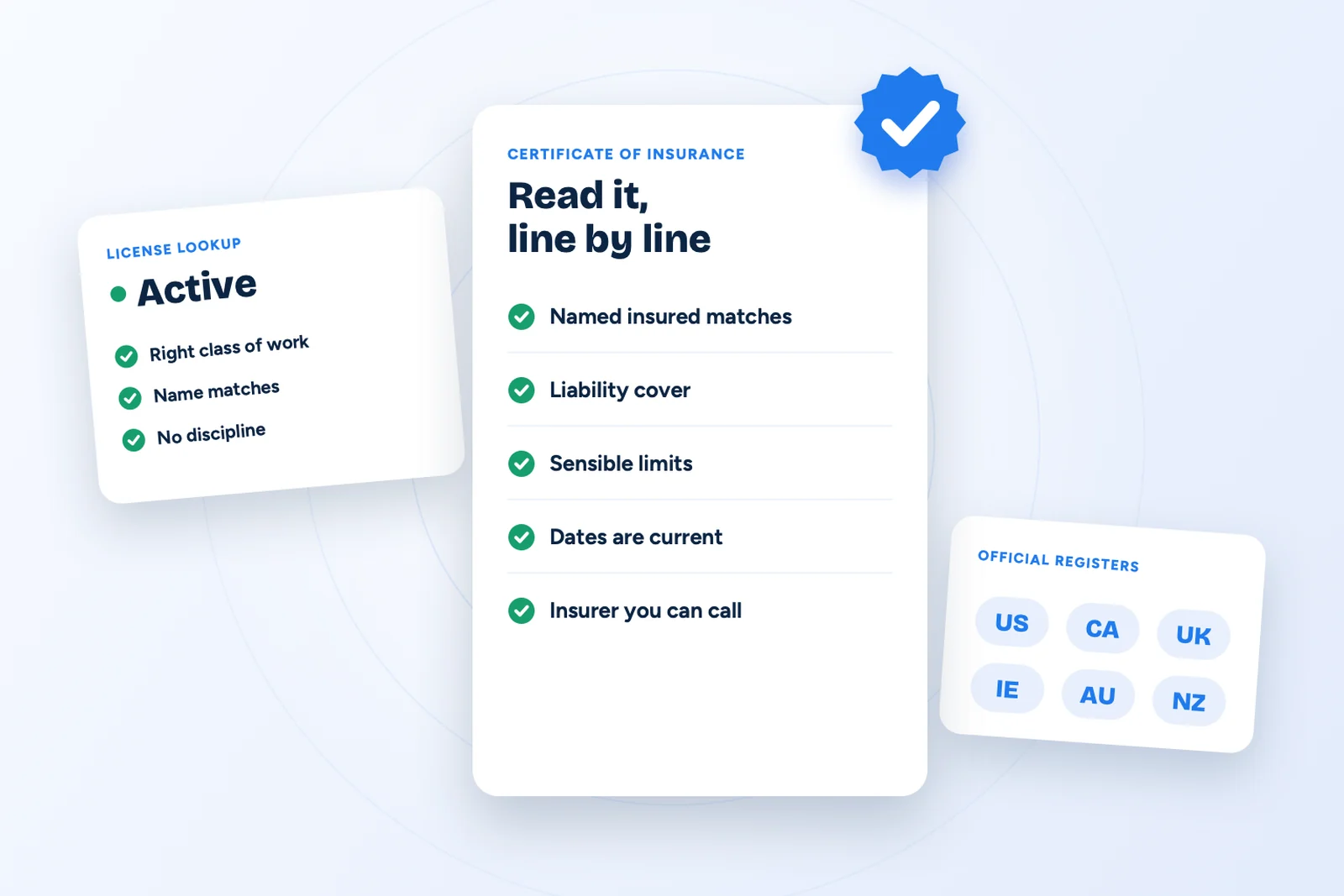
Ask for the license number and the exact name it is issued to. Then look it up on the official register: your state or local licensing board's website in the US, and the national or provincial registers in Canada, the UK, Ireland, Australia and New Zealand. Confirm three things: the license is active, the license type matches the work you need, and the name matches the person or business you are hiring. Many lookup tools also show expiration dates and any public disciplinary actions.
If a contractor will not share a license number for work that clearly needs one, that tells you something. Move on to the next name on your list. Our guide shows how to look up a license and read an insurance certificate.
Ask for proof of insurance, not a promise
Insurance matters if something goes wrong on your property. General liability coverage can respond to damage the contractor causes, and workers' compensation matters when a contractor has employees who could be injured at your home. Requirements vary by country, state and job, so ask what applies to yours.
“I'm fully insured” is not proof. Ask for a certificate of insurance, and check the policy dates, the business named on it, and the type of coverage. Some apartment buildings and property managers require a certificate that names them before any work begins, so ask early. If anything looks unclear, call the insurance agent listed on the certificate and confirm the policy is current.
Read reviews that come from real jobs
Reviews are only as good as the rules behind them. On some sites, anyone can leave a rating. On Taskovery, only a customer who hired the contractor and saw the job through to Completed can review them, and each review publishes about half a day after it is written. Contractors can reply publicly.
Read for detail rather than the star count. Look for comments about arriving on time, explaining the work, protecting the home, cleaning up, and sticking to the agreed price. One poor review is not a verdict. A pattern is. Photos of past work help too, especially work that looks like yours. For the rest of a profile, see how to vet a contractor online.
Confirm the details before work starts
The last check happens in conversation. Make sure the name on the profile matches the person you are speaking with and the business on any estimate. Ask who will actually do the work, because a crew member or subcontractor may not be the person whose profile you reviewed.
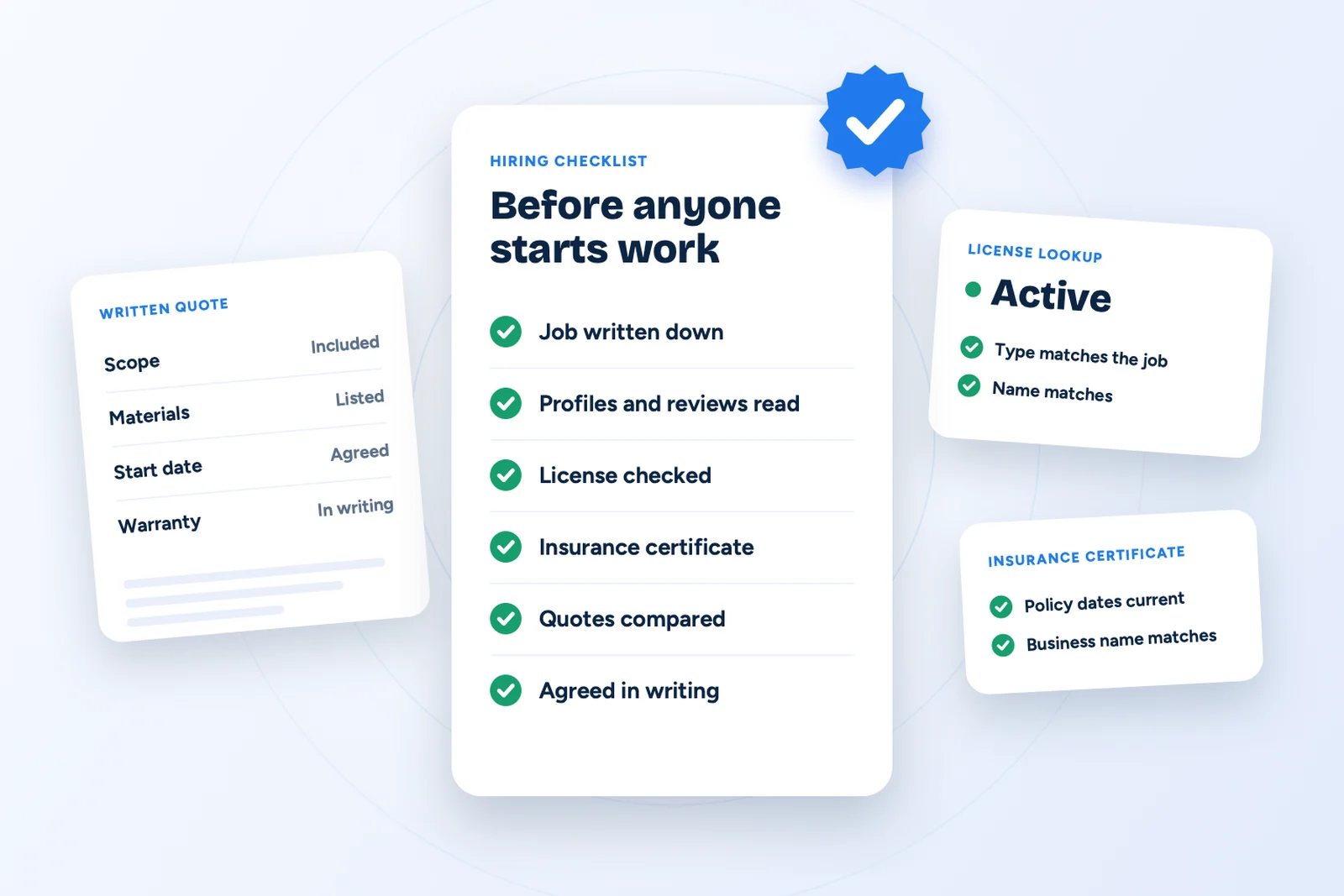
Before anyone starts, have these in writing:
- The scope: what is included and what is not
- The price, or exactly how the price will be worked out
- The license number, if the job needs one, checked on the official register
- A current certificate of insurance, if the job calls for it
- The payment schedule, including any deposit and when the balance is due
On Taskovery, you pay your contractor directly on their own invoice, so agree on payment terms with them before work begins. For a longer list, see the questions to ask before anyone starts.
Red flags a badge will not catch
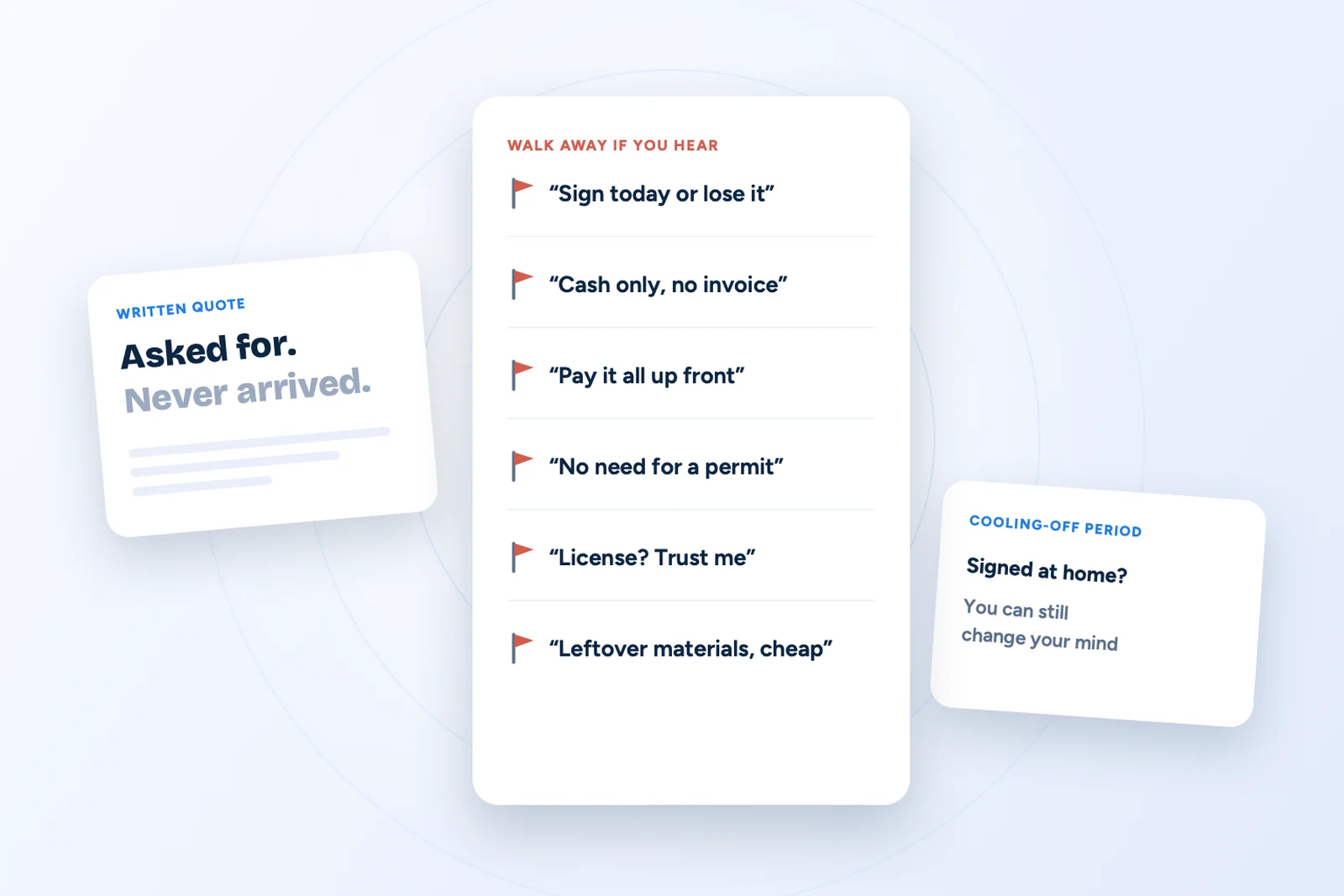
Verification cannot tell you how a contractor behaves under pressure. Slow down if someone asks for a large cash payment before explaining the work, refuses to put the scope or price in writing, will not share a license number for licensed work, or pushes you to decide on the spot. A price far below every other quote, with no clear reason, deserves a second look as well. There is more in the full list of contractor red flags.
Mismatched details are worth noticing too. If the names on the estimate, the license, the insurance certificate, and the invoice do not line up, ask why before you pay anything. There is often an ordinary explanation, such as a trading name or a parent company, and a professional will give it without fuss. Keep copies of the estimate, the certificate, and your messages, so there is a clear record if a question comes up later.
The right contractor will not mind being checked. A verified mark tells you who you are dealing with. Your own checks tell you whether they are the right fit for your job, your home, and your budget. Use both, and keep the final decision yours.
Need this done?
Describe the job once and contractors near you get in touch. It costs you nothing.