How to Check a Contractor's License and Insurance
How to check a contractor's license and insurance: where to look it up in six countries, how to read a certificate of insurance, and what to do next.
Two checks do more to protect you than any badge, review or recommendation: a license that covers the work, and insurance that pays if something goes wrong. Both take a few minutes, both can be done from your phone, and both are skipped far more often than they should be. Knowing how to check a contractor's license and insurance is the difference between trusting someone and having checked.
This guide explains what each check tells you, where to look in the six countries Taskovery covers, how to read a certificate of insurance line by line, and what to do when the details do not match. It is one step of the full hiring checklist, and probably the one that matters most for licensed trades.
Why these two checks matter
A license says the person or business has met a regulator's standard for a kind of work, and it gives you somewhere to complain if the work falls short. Insurance says who pays if the contractor damages your home, injures a neighbor, or has an employee hurt on your property. Without the first you have no regulator. Without the second, the bill for an accident can land on you or your own insurer.
Neither check says the work will be good. A licensed, insured contractor can still be slow, messy or expensive. What the checks do is remove the worst outcomes, which is why they come before anything else.
How to check a contractor's license
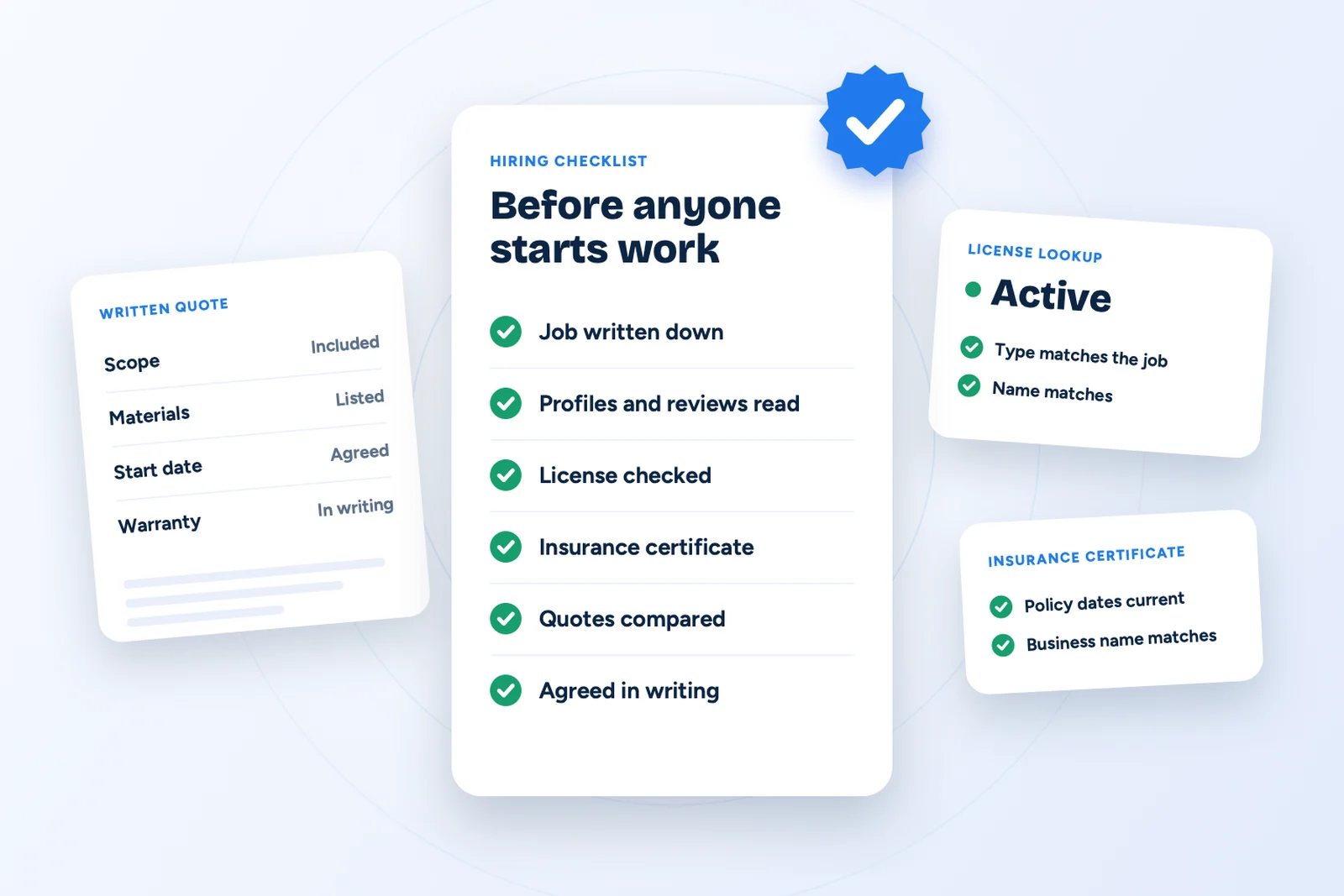
Ask for the license or registration number and the exact name it is issued to, in writing. Then look it up yourself on the regulator's own website rather than following a link the contractor sends. You are checking four things: the license is current rather than expired or suspended, the class of license covers your kind of work, the name matches the person or business you are about to pay, and there is no discipline you would want to know about.
Names deserve attention. Licenses are often issued to a person while the quote comes from a company, or to a company that trades under a different name. That can be entirely normal, but ask how the two connect, and make sure the licensed person is the one doing or supervising your job.
Some registers also show the conditions on a license, such as work the holder may only do under supervision, or the date it was first issued. A license held for twenty years is not proof of quality, but a license issued last month for a large job is worth a question.
Where to look it up in each country
In the United States, licensing is set state by state, and some cities and counties add their own. Your state's contractor licensing board runs a free lookup, and trades such as electrical and plumbing often have their own board. In Canada, trades are regulated by each province and territory; in Ontario, the Electrical Safety Authority licenses electrical contractors and publishes a lookup.
In the United Kingdom, anyone working on gas must be on the Gas Safe Register, which you can check with the number on the engineer's ID card. In England and Wales, notifiable electrical work in a home is signed off by building control or done by an electrician registered with a competent person scheme such as NICEIC or NAPIT. In Ireland, gas work must be done by a Registered Gas Installer, and electrical contractors register with Safe Electric.
In Australia, electricians, plumbers and gasfitters are licensed in every state and territory, and the state or territory regulator runs the licence search. In New Zealand, the Plumbers, Gasfitters and Drainlayers Board and the Electrical Workers Registration Board both keep public registers, and restricted building work must be done or supervised by a Licensed Building Practitioner. Our hiring guide lists where to check a license in each country, with links to the registers.
When a license is not required
Plenty of work needs no license at all. Cleaning, moving, furniture assembly, most garden work and small handyman repairs are unlicensed in most places. Some US states set a dollar limit, counting labor and materials together, below which small jobs need no contractor license, while gas and electrical work are licensed or tightly controlled almost everywhere, whatever the job costs.
If a job needs no license, the insurance check matters even more, because it is the only formal protection you have. And if you are not sure whether your job needs one, ask the regulator, not the contractor.
Membership of a trade association is not a license, but it can still tell you something. Many associations check qualifications, insurance or references before they admit a member, and run a complaints process of their own. Check the member directory on the association's own site rather than trusting a logo on a van, and read what membership actually requires.
How to read a certificate of insurance
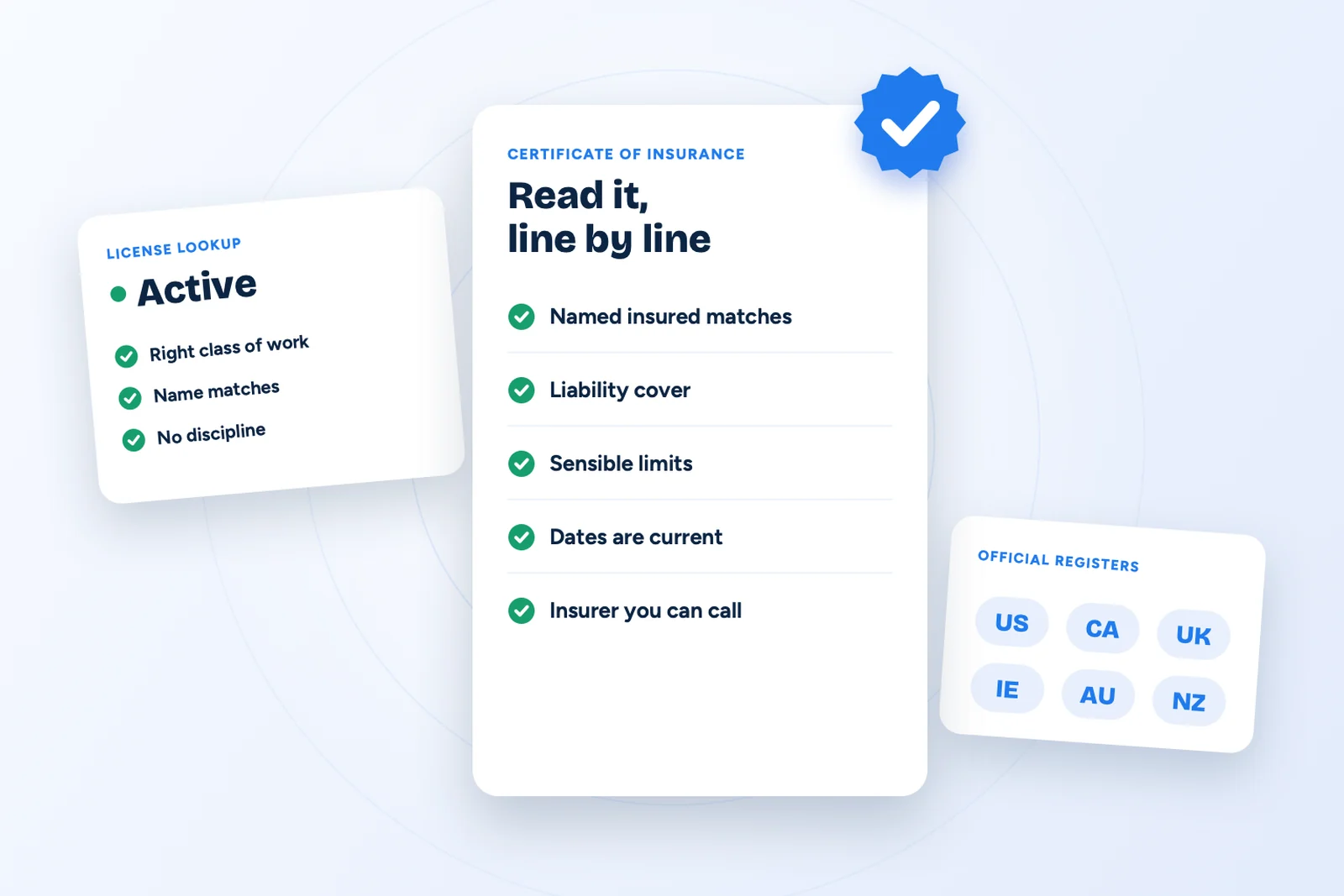
"Fully insured" is a phrase, not a policy. Ask for a certificate of insurance, which the contractor's insurer or broker can issue in minutes, and read it properly:
- The named insured: the business name should match the quote and the license
- The type of cover: general or public liability, which pays for damage to your property or injury to others
- The limits: how much the policy pays per claim, which should be sensible for the size of the job
- The dates: the policy should be current on the day work starts and run until it finishes
- The insurer or broker: a name and a phone number you can call to confirm the policy is live
- The certificate holder: if your building or property manager needs to be named, check that they are
Certificates can be out of date or, occasionally, altered. If anything looks wrong, call the insurer or broker on a number you find yourself and ask them to confirm the policy.
Workers' compensation and employer cover
If the contractor brings employees, their injuries need cover too. In the US and Canada that is workers' compensation, and in the UK and Ireland it is employers' liability insurance, which is compulsory for most employers in the UK. Without it, an injured worker may look to the property owner.
In Ontario, the WSIB issues free clearance certificates showing that a contractor's account is in good standing, and anyone can generate one at wsib.ca. Other provinces run similar checks through their workers' compensation boards. Ask for the equivalent wherever you are, especially for bigger jobs with a crew.
What a platform's badge does and does not check
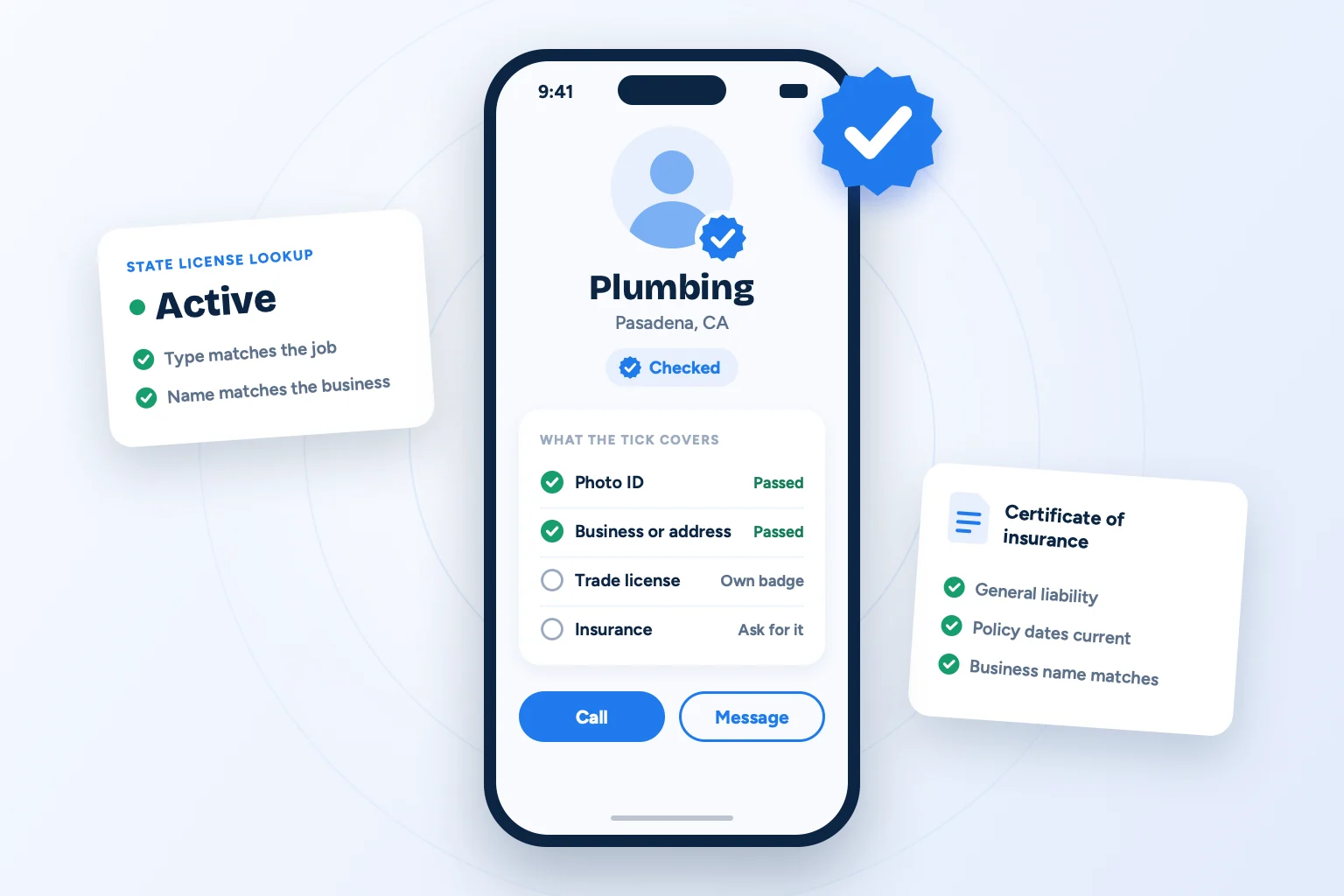
Every site decides what its badges mean. On Taskovery, the tick means every check the contractor's account requires has passed: a photo ID, plus a business registration check for a company or a proof of address for a sole trader. A trade license is a separate, optional badge, the tick is not a criminal background check, and insurance is not checked at all. Read what a verified badge does and does not check before you rely on one, and do the two checks in this guide yourself either way.
What to do if something does not match
Most mismatches have an ordinary explanation: a trading name, a parent company, a license renewal in progress, or a certificate that was reissued this week. Ask, and give the contractor the chance to explain it or send the right document. A professional will do that without fuss.
Keep a record of what you checked: a screenshot of the register entry with the date, and a copy of the certificate of insurance. If anything goes wrong later, you will want to show what the contractor held on the day the work started, and registers only show what is true today.
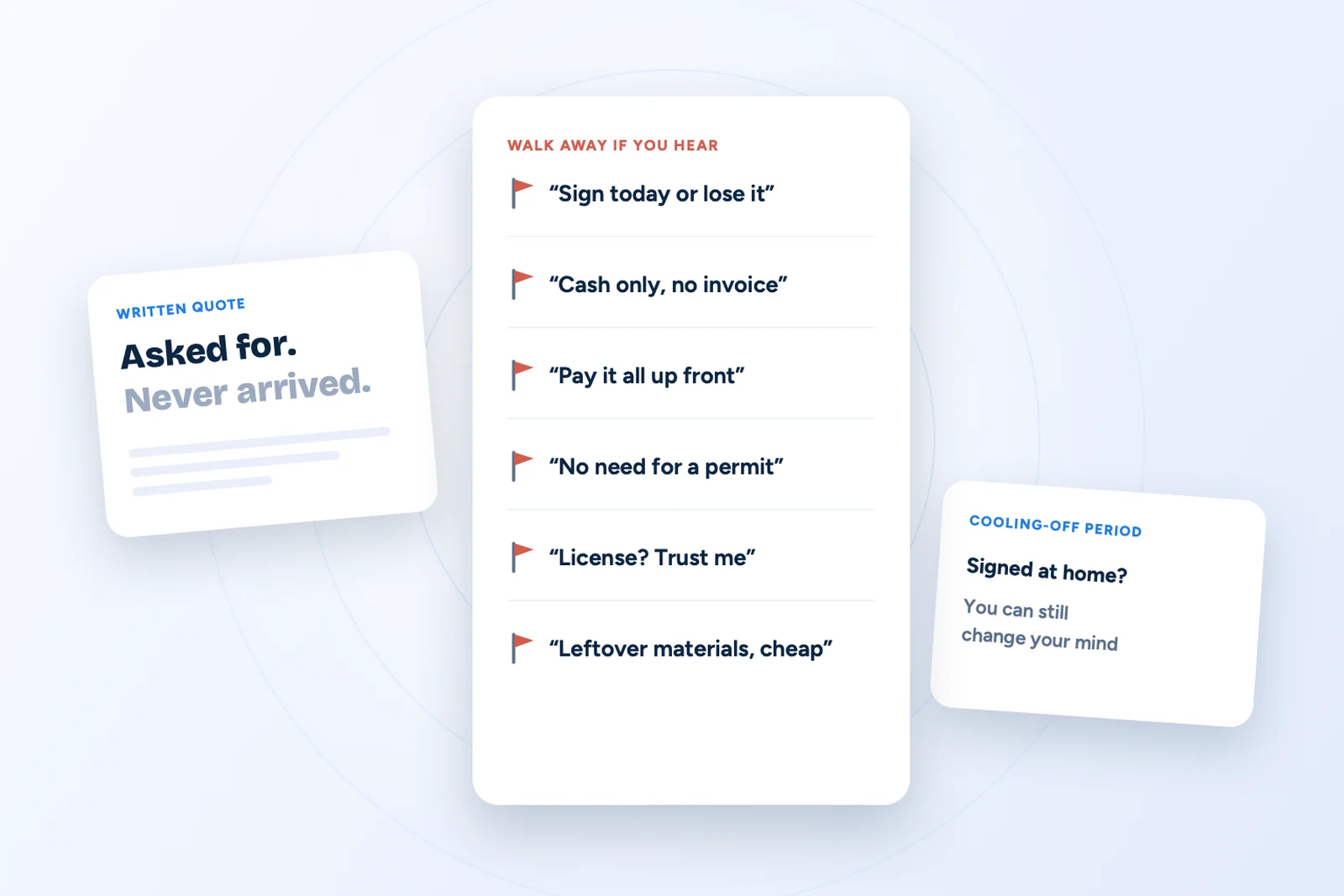
Walk away if the license is suspended, expired or the wrong class for your work, if the insurance cannot be confirmed with the insurer, or if the contractor gets defensive about being checked. Then keep going with the rest of your list, starting with the questions to ask next. The right contractor expects to be checked, and is usually glad you did.
Need this done?
Describe the job once and contractors near you get in touch. It costs you nothing.