How to Vet a Contractor Online: Profiles and Reviews
How to vet a contractor online in fifteen minutes: read a profile in the right order, judge reviews and photos, spot bought signals, check licenses.

Three profiles, three photographs of somebody in a clean work shirt, three sets of five stars. When you vet a contractor online, the hardest part is not finding people. It is working out which parts of a profile are evidence and which parts are decoration.
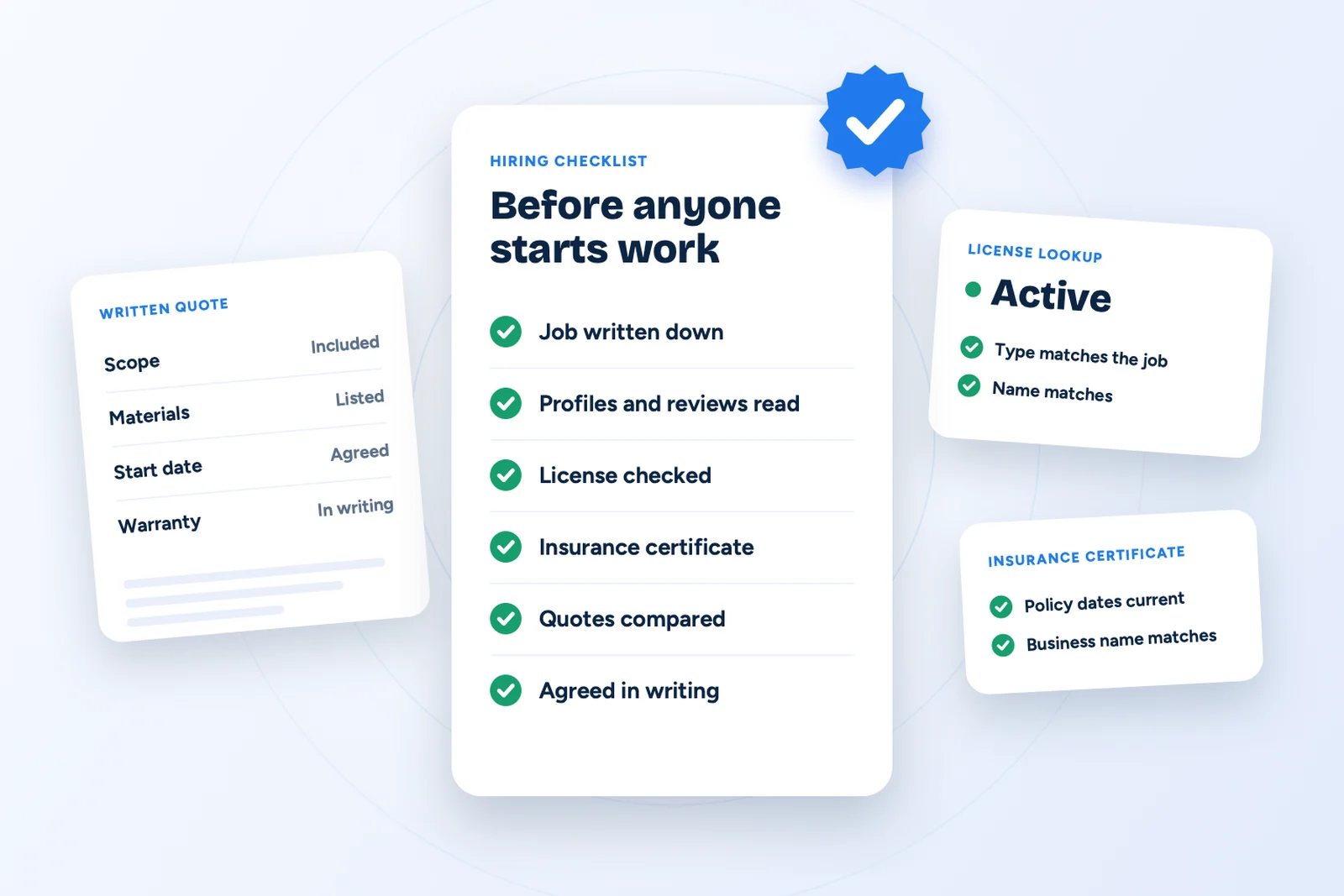
Profiles are built to be persuasive, and a fair number of the signals on them can be bought, written by the contractor, or left over from a different kind of work than yours. This is a way to read them in an order that puts the checkable things first, so a shortlist of three takes fifteen minutes instead of an evening. It is one step of the full hiring checklist.
Start with your job, not with the profiles
Write the job down before you read anybody: the trade, what needs doing, when you need it, and roughly what you expect to spend. A contractor cannot be right or wrong in the abstract. They are right or wrong for a leaking shower in an upstairs bathroom in the next two weeks.
Decide your must haves too. Licensed for this class of work, available in your window, covers your neighborhood, can handle the access, has done this size of job before. Everything else is a preference, and preferences are what you use to break a tie.
Write down what would make you say no, as well. A contractor who cannot start for six weeks is wrong for a leak and perfectly good for a deck. Knowing that in advance stops a persuasive profile from talking you out of your own deadline.
Read a profile in this order
Trade and service area first. A profile that names the cities or states it covers is telling you something specific, and one that claims to cover everything is telling you nothing. If the trade listed is not the trade you need, stop reading, however good the rest looks.
Then verification, then reviews, then photographs of past work, then how fast they reply. Read the written bio last. It is the part the contractor wrote about themselves, and it is the least checkable thing on the page, though it does tell you how carefully they explain things.
Pay attention to what is missing. No service area, no license number for licensed work, no photographs of finished jobs, or a profile that has been up for a year with nothing on it are all worth noticing.
Notice how recently the profile has been active, too. Somebody who answered a job last week is available in a way that a profile last touched in March is not, and most sites show this somewhere even when they do not label it plainly.
How to vet a contractor online without being sold to
Know how the list you are reading was ordered. On most platforms some contractors pay to appear higher, and that is legitimate as long as it is disclosed. What you want is a way to look that money cannot influence.
On Taskovery, a bought week of placement lifts a contractor in the Best match sort and marks them Promoted on the card itself. Closest is genuinely closest and Top rated is genuinely top rated, and neither can be bought at any price. You can read exactly how paid placement works before you rely on any ordering. On search engines, the results above the organic ones are ads, and the same rule applies: read them, but know what you are reading.
The practical move is to sort by something unbuyable, take the top few, and then compare those on evidence rather than position.
What reviews tell you, and what they hide
The rules behind a review system matter more than the average score. Ask who is allowed to leave one. On Taskovery a review can only come from a customer who hired that contractor and saw the job through to completed, one job and one review, and the contractor can reply publicly. Where anybody can post, a five star average means much less.
Read the three most recent reviews and any one star review in full. Detail is the signal: turned up when they said, explained the options, protected the floors, cleaned up, charged what was quoted. Vague praise is filler. One bad review among many is a bad day, a pattern of the same complaint is a warning, and a reply that argues with a customer tells you how a disagreement with you would go.
Check that the reviews describe work like yours. Twenty glowing reviews for furniture assembly say little about a rewiring job.
Look at where the rating comes from as well. A star average the platform calculates from completed jobs means something. A number typed into a profile by the business itself means nothing, and at a glance the two look identical.
Photographs of past work
Photographs are the closest thing to a portfolio you get online. What you want is a job told in a few pictures, before, during and after, of work that resembles yours. A single hero shot of a finished kitchen could be anyone's.
Watch for stock photography, the same tidy van in three different profiles, or images with a different season or architecture than your area. If the photographs are real and the work looks like yours, that is worth more than any badge on the page. A contractor with nothing to show can still be excellent, so ask for a couple of recent references instead.
Verification, licenses and insurance
Understand what the badge on the profile means on that particular site, because the word verified is not a standard. On Taskovery the tick means every check the account requires has passed: a photo ID, plus a business registration check for a company or a proof of address for a sole trader. It is not a workmanship guarantee, and a trade license is a separate optional check with its own badge and status. Read what verified actually covers before you lean on it.
Then do the two checks nobody else can do for you. Look the license up on the official register, your state licensing board's site in the US or the national or provincial register elsewhere: active, right type, right name. Ask for a certificate of insurance and read the dates and the business name. Those two minutes outrank every badge on every profile.
The signals that mean less than they look
Some things on a profile carry almost no information. Years in business, where nothing verifies the claim. The phrase fully insured with no certificate behind it. Award badges from schemes that sell them. Follower counts. A logo. A long list of trades, which often means a marketing company rather than a tradesperson.
Response time is worth more than most of those, because somebody who replies in an hour during the shortlist stage usually replies when the job is running late too. So is a quote that lists what is included rather than one number, and so is a person who asks you questions before giving a price.
Be wary of the profile that is entirely about the company and never about the work: the stock van, the team photograph, the paragraph about values and passion. Somebody who fixes things for a living usually finds it easier to show you a fixed thing.
Turn a shortlist into a decision
Take three names off the list and treat them identically:
- Send exactly the same scope, photographs and dates to all three
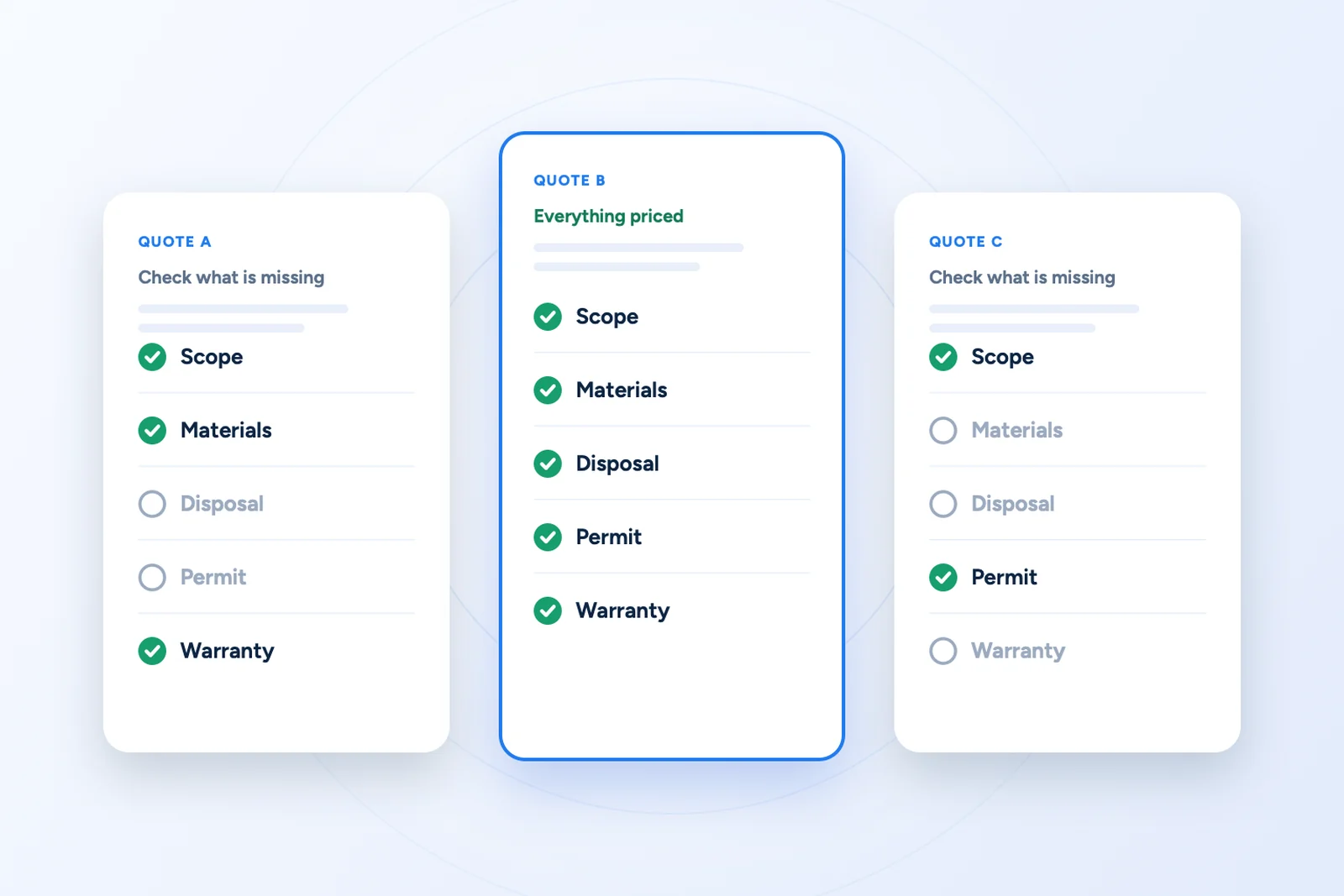
- Ask each for a written quote that lists what is included and excluded
- Ask the same questions, including license number and insurance
- Check each license yourself, and each certificate of insurance
- Compare on inclusions and availability, not on the bottom line alone
- Pick the one who explained things most clearly, if the numbers are close
Once the prices are in, compare the quotes themselves line by line, not just the totals.
If chasing three quotes sounds like work, turn it around and post the job once instead, so the contractors come to you with the same information in front of all of them. Either way, the decision is yours, and profiles are only ever a way of deciding who to talk to.
Need this done?
Describe the job once and contractors near you get in touch. It costs you nothing.