Pay Per Lead vs Subscription for Contractors
Pay per lead vs subscription for contractors: how lead fees, shortlist fees, memberships and commission compare, and how to work out a won job's cost.
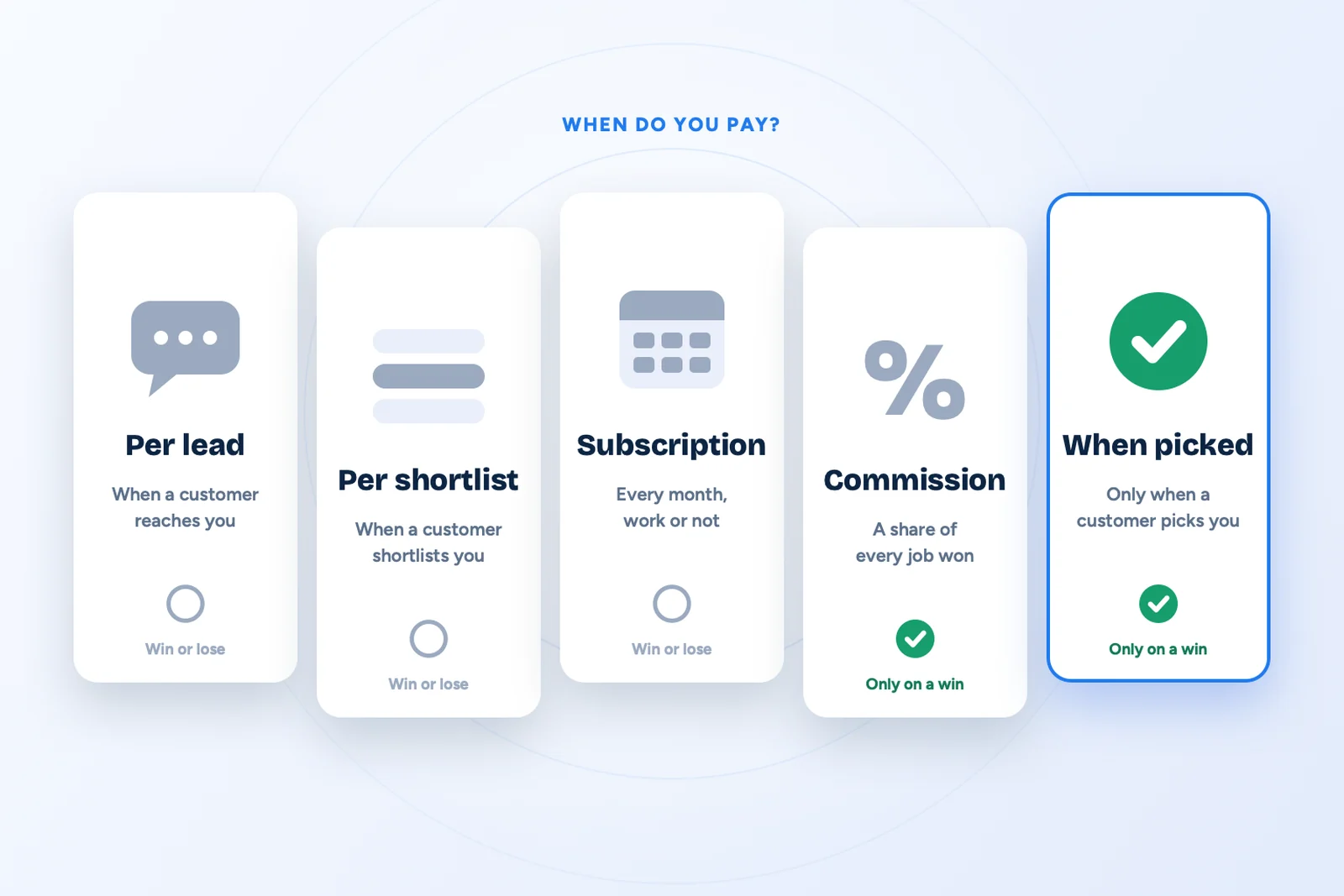
Every lead site says it brings you customers. What differs is when it charges you, and for what. Some charge the moment a customer's details reach you, some when a customer shortlists you, some every month whatever happens, and some take a slice of the finished job. Comparing pay per lead vs subscription is really comparing who carries the risk when a customer goes quiet.
This guide explains the five common models, with examples from sites contractors use in the US, the UK, Australia and New Zealand, and shows how to work out what a won job actually costs you. Prices and terms change often, so treat the examples as a description of each model as the sites set it out in September 2026, not as a price list. For the wider picture, see our guide to getting more jobs without commission.
The five ways lead sites charge
Most sites use one of these, and some combine two:
- Pay per lead: you pay each time a customer's details or message reaches you, whether or not you win the job
- Pay per shortlist: you pay when a customer shortlists you and your contact details are exchanged
- Subscription or membership: a fixed monthly or yearly fee, sometimes with a set number of leads included
- Commission or service fee: a percentage of the job's price, taken only when you are hired
- Pay when picked: a set charge that applies only when a customer chooses you for the job
A subscription that pre-pays for leads, or a plan with tokens that are spent on each connection, is a mix of two of these. The questions at the end of this guide work for all of them.
Pay per lead: paying for the chance
This is the model most US contractors know. Thumbtack's help pages say pros pay for leads, meaning new customers who reach out to them directly, and that pros set their own lead prices. For its open opportunities, a pro reaches out first and pays the price shown only if the customer responds. Angi's terms for pros say leads are not guaranteed jobs and that a lead is frequently sent to several other pros. Bark, which runs in all six of the countries we cover, sells credits you spend to contact a customer, with the cost shown before you commit.
The appeal is control. You choose which leads to pay for and can set a budget. The catch is that you pay for conversations, not jobs. If four contractors pay for the same lead, three of them paid for nothing, so your cost per won job depends entirely on your win rate.
Pay per shortlist: paying when you are picked out
In the UK, MyBuilder lets tradespeople show interest in jobs for free and charges when a homeowner shortlists them, which is the point where contact details are exchanged. Its help pages say there are no joining or membership fees, and also that being shortlisted does not guarantee you will make contact, quote or win the job.
A shortlist fee cuts some of the waste of pure pay per lead, because the customer has chosen you over the others. You are still paying before the job is won.
Subscriptions and memberships: a fixed cost
Membership directories charge a monthly fee for a listing, and the dearer plans include leads. Checkatrade in the UK has published a basic plan from £30 plus VAT a month that lists you without supplying leads, with lead-based plans priced separately. In New Zealand, Builderscrack sells subscription plans with a balance of tokens and deducts tokens when a homeowner accepts your request to connect on a job. Angi also offers pros an automatically renewing, fixed-term subscription that pre-pays for leads at a discount.
A subscription is predictable, which helps with budgeting. It is cheapest when you are busy and most expensive when work is slow, and many plans come with a fixed term. Read the cancellation terms before you sign, not after.
Commission: a cut of every job
Commission charges nothing until you are hired, then takes a percentage of the price. Airtasker's Australian help pages say its service fee for Taskers ranges from 12.5% to 20% of the task price, depending on their tier, plus tax, and is charged once a Tasker is assigned the task.
Commission feels fair because you pay only on work you win. It gets expensive as jobs get bigger: 15% of a $200 job is $30, but 15% of a $5,000 job is $750. It also usually means the platform handles the payment, so your money passes through it before it reaches you.
Pay only when you are picked
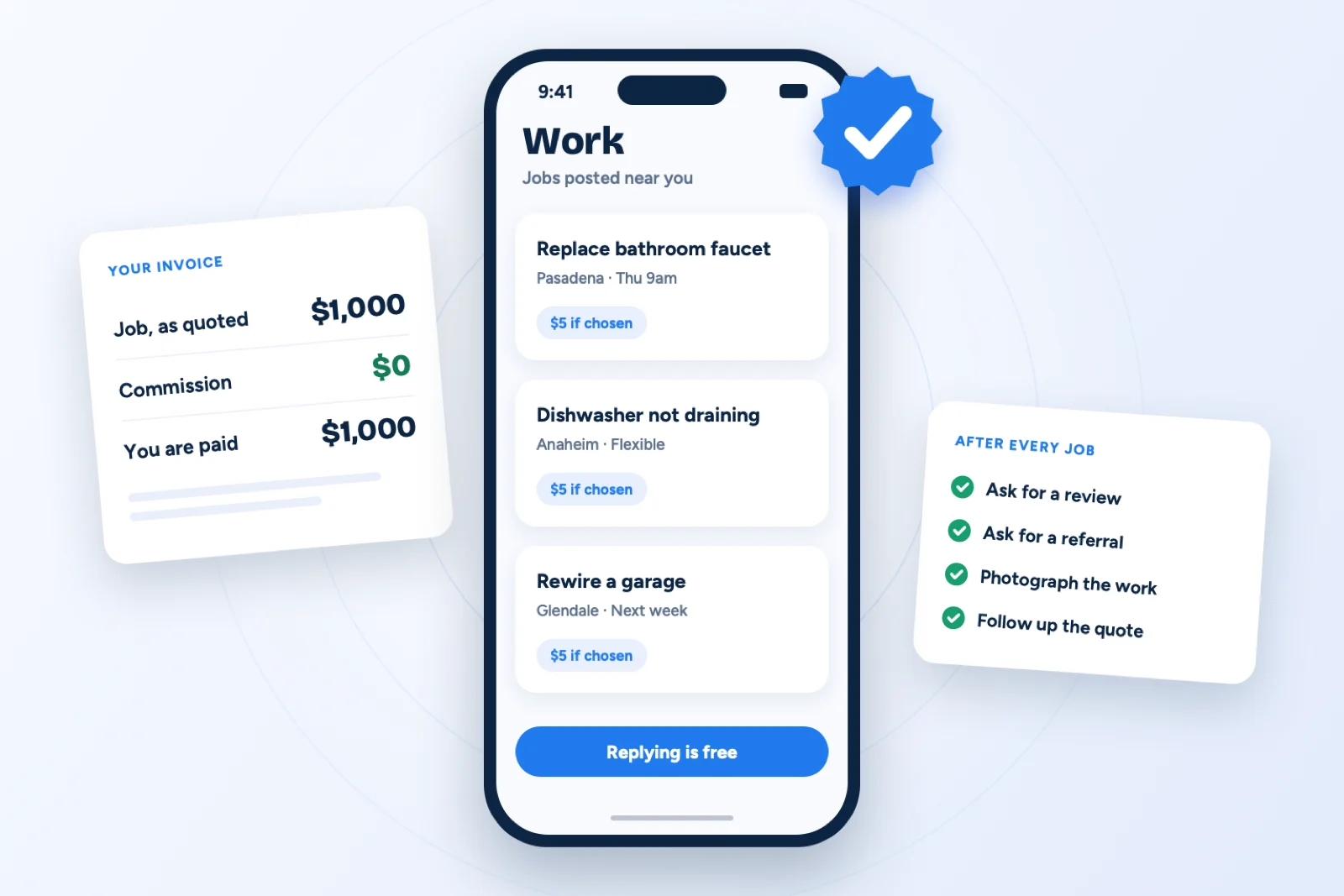
Taskovery is free to join, with no commission on your work. On the Free plan you reply to the jobs customers post in your trades and area and take calls from an available number on your profile in the app, and you pay a flat hire fee only when a customer chooses you: 5 for any job posted before 1 January 2027, then 9 for a small job, 29 for a medium one and 59 for a large one, in your service country’s currency, shown on the job before you reply. Chatting with customers while they decide is free. Pro, at 149 a month, has no hire fees and adds direct introductions from our team, personal partner support and a Featured partner badge. You agree your price with the customer and invoice them directly. Compare the plans.
Pro is a recurring cost, whether a month is busy or quiet. Taskovery’s first-customer guarantee covers the first Pro payment if no customer chooses you within 14 days. The request deadline and full conditions are on the partner page.
Work out your cost per won job
Whatever the model, divide what a source cost you by the jobs it actually produced. With round numbers, for illustration only: pay per lead at $40 a lead, winning one in four, costs $160 a won job. A $150 monthly subscription that brings three jobs costs $50 a job, and $150 in a month that brings one. Commission at 15% costs $150 on a $1,000 job and $450 on a $3,000 job. On Taskovery’s Free plan a won medium job costs a flat 29, however many others you answered; Pro at 149 a month works out at about 50 a job over three won jobs. That is an example calculation, not a promise of three jobs.
Track it over two or three months, not one week, because every source has quiet spells. Count your time as well as your money: a lead that takes an hour to quote and goes nowhere cost you that hour too.
Which model suits which contractor
Pay per lead suits contractors with a high win rate and the time to answer quickly, because speed decides who converts a shared lead. It punishes anyone who cannot reply within the hour. Subscriptions suit established businesses with steady demand, who can predict a monthly cost and use every lead a plan includes, and they suit a new business less, since a slow first season costs the same as a busy one.
Commission suits small, occasional jobs and people starting out, since there is nothing to pay until you are hired. As your jobs get bigger, the percentage grows with them. Paying only when picked suits contractors starting out or growing, since a quiet month costs nothing, and a flat plan with no per-job fee suits busy ones who win often and want work brought to them.
Whatever you choose, do not rely on one source. The contractors who are busiest year round usually combine one or two paid sources with the free ones: referrals, repeat customers and their own map listings.
Questions to ask any lead site before you sign
How many other contractors get the same lead? Do I pay if the customer never replies? Is there a contract, how long is it, and what does leaving early cost? Can I get credit for a fake or wrong lead, and how long do I have to ask? Do unused credits or leads carry over? Does the site sit in the payment, and when do I get my money? What does the customer see about me, and can anyone pay to appear above me?
A site that answers all of these plainly and in writing is usually worth a trial. For the sites themselves, country by country, see Angi and Thumbtack alternatives.
Need this done?
Describe the job once and contractors near you get in touch. It costs you nothing.