Junk Removal for a Rental Property: A Landlord Guide
Junk removal for rental property turnarounds: the notice rules for a tenant's belongings, what crews cannot take, and how volume pricing really works.
A tenant has moved out and left half a household behind: a sagging couch, a broken television, bags in the hallway, a refrigerator nobody wants. Every day that stays in the unit is a day the property earns nothing, so junk removal for rental property turnarounds is usually the first call a landlord makes.
Clearing a rental between tenants? Post the junk removal job free and hear from verified local removalists.
Make one check before that call. Property left behind by a tenant is not automatically yours to throw away, and the rules that say so are written state by state. Get that part right, and the rest of the job is straightforward: price the volume, book the right crew, and keep the paperwork that protects your deposit statement. For choosing the crew itself, run through the full hiring checklist.
Check the rules before anything goes in a truck
Most states treat a tenant's belongings as the tenant's until a specific process has been followed. The common pattern is a written notice that lists the property, says where it is stored and what it will cost to collect, and gives a deadline, often somewhere between seven and ten days, delivered in person or mailed to the last known address.
Storage periods vary more than people expect. Washington requires written notice and holding the property for a set period before disposal, Texas and Vermont give renters around sixty days, and Indiana runs to ninety. Some states let you charge the tenant for storage, some allow a sale, and some let you dispose of low value items much sooner. Your own state's landlord and tenant statute is the only source that matters, and a local attorney or your state's housing agency can confirm it in one call. The examples here are American. In Canada, the UK, Ireland, Australia and New Zealand the same question is answered by provincial, state or national tenancy law, and for anything of value the principle is the same: notice first, disposal later.
None of this applies if the tenancy has not legally ended. An abandoned looking unit is not the same as an abandoned tenancy, and clearing one out early is how landlords end up paying damages. Before anything moves, photograph every room and make a written inventory with dates.
Separate the junk from the fittings
Walk the unit with two lists. One is rubbish: broken furniture, bagged waste, food, worn bedding, anything with no value to anybody. The other is property that belonged to the unit, or that has real value: appliances that came with the lease, window coverings, a mattress in good condition, tools, electronics.
The second list matters for two reasons. Items with value are the ones a notice process protects, and items that came with the unit are repairs rather than rubbish. Keep them apart in your photographs too, because an itemized deposit statement written from a clear record is much harder to argue with than one written from memory.
Whatever is worth keeping has to go somewhere. If furniture is moving to another unit or into storage rather than into a truck, labor only moving help is usually cheaper than paying a junk crew to carry the same couch twice.
How junk removal for rental property is priced
Junk removal is normally priced by volume: how much of the truck your pile fills, in fractions, with a minimum charge for a small load. Labor is the other half of the number. A second floor walk up with a long carry to the street costs more than a garage you can back a truck into, and crews will say so on the phone if you describe the access honestly.
Some items carry their own fees because the disposal site charges for them. Mattresses, tires, paint, televisions and refrigerators are the usual ones. A quote that does not mention disposal fees is a quote that will grow, so ask what the total includes before the crew starts loading.
For a whole house clear out, compare a junk removal crew with a rented dumpster. The dumpster is cheaper per cubic yard and you supply the labor, but check whether your city needs a permit for one on the street and how long it can stay. To have crews quote your job instead of calling around, post the job with photos of the pile and a note about stairs and parking. That is most of how to describe the job.
Ask what the minimum charge covers, and expect a volume quote to be confirmed when the crew sees the pile. Most arguments about junk removal come from a photograph taken at a flattering angle and a truck that turns out to be smaller than the pile.
What a crew cannot take
Hazardous material is refused almost everywhere, and for good reason. Paint, solvents, pesticides, pool chemicals, propane tanks, automotive fluids and car batteries all need a household hazardous waste facility, and most counties run drop off days for exactly this. Asbestos containing material, from old floor tiles to pipe lagging, needs a licensed abatement contractor and is never a general junk job.
Refrigerators, freezers and air conditioners contain refrigerant that has to be recovered by somebody certified before the unit is scrapped. Electronics and tires are regulated separately in many states, and several states ban mattresses from landfill and run their own recycling programs instead.
If a unit is genuinely filthy rather than just full, say so when you book. Needles, rodent infestation or human waste are specialist cleanup work with different equipment and different insurance, and a general crew is right to decline them.
Donate and recycle what you can
Ask any crew what happens to the load after it leaves. Good operators sort it: furniture in usable condition to a reuse charity, metal to a scrap yard, electronics to a recycler, and only the remainder to landfill. Some will hand you donation receipts, which can matter at tax time if the items were yours.
It is also a better story for the neighborhood than four truckloads to a hole in the ground, and it often costs no more. Where you have time rather than money, local reuse groups will collect a working couch for free.
Booking the job so it runs in one visit
Crews price from information. Give them enough of it and you get a firm number instead of a range that grows on the day:
- Photographs of every room and pile, including the garage, the balcony and any storage locker
- The floor, whether there is an elevator, and how far the truck must park from the door
- A list of the heavy or special items: appliances, mattresses, televisions, paint, tires
- Whether anything is to be kept, and where it should be moved to
- Who will let them in, and whether the power and lights are on
- The deadline, if a new tenant is already booked
Ask for a written quote that names the disposal fees, and ask for a receipt or disposal record when the work is done. That receipt is the evidence behind any amount you charge against a deposit.
Do the turnaround in the right order
Clear the unit first, then repair, then paint, then clean, then photograph. Doing it any other way means cleaning twice. A cleaner walking into a unit full of furniture cannot do the job you are paying for, and a painter working around boxes leaves edges.
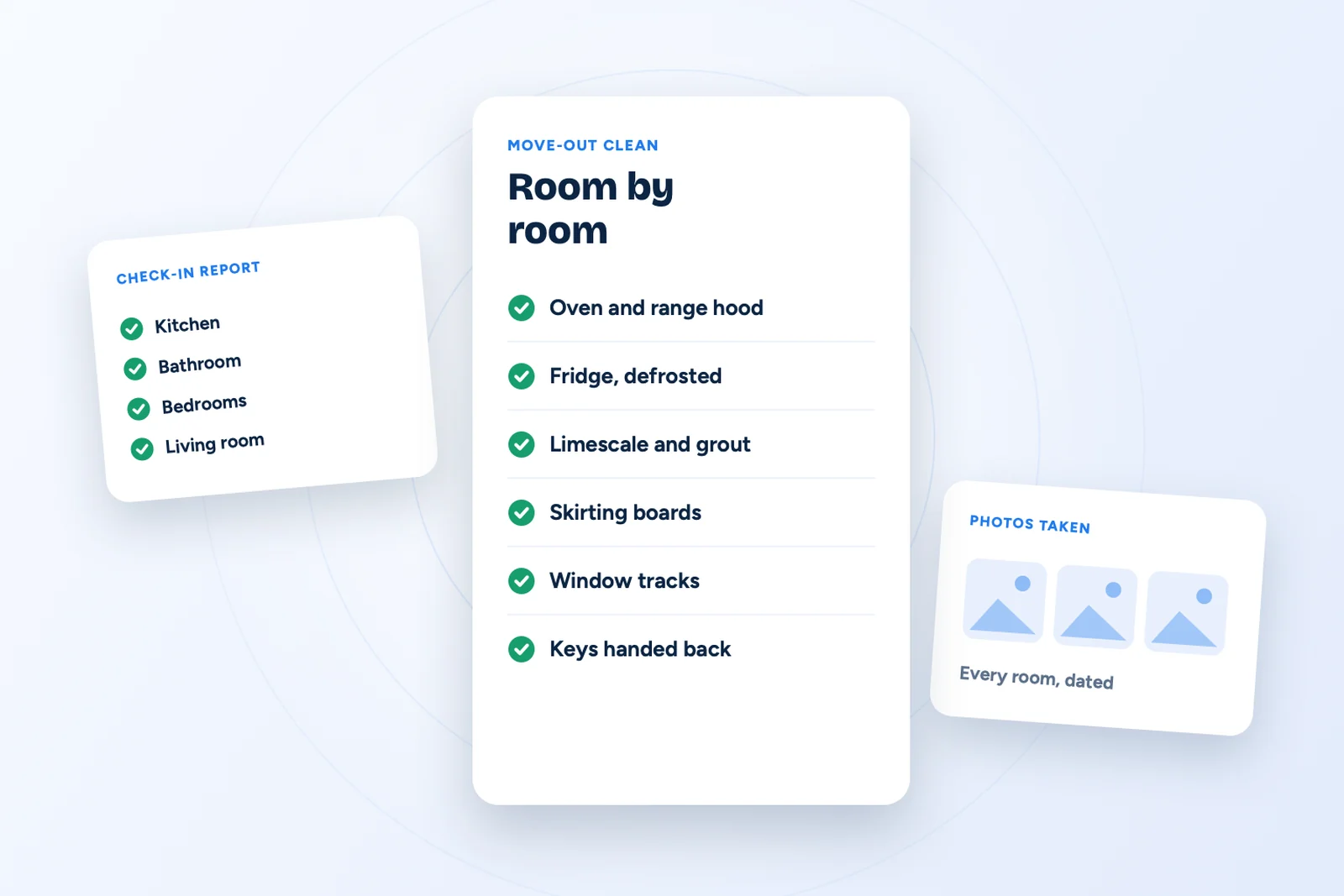
Book the cleaner for the day after the junk crew, not the same afternoon, and give the repairs enough room to run late, because they usually do. When the unit is empty and clean, take a full set of photographs before the new tenant moves in. They are the baseline for the next inspection, and they are also the pictures that let the listing go live. For what a good apartment clean covers, see hiring a cleaner for an apartment, and use the checklist for a move-out clean to check the result.
The paperwork that protects you
Keep four things in one folder for each turnaround: the dated photographs and inventory from before anything was moved, copies of any notice sent to the tenant with proof of mailing, the removal and disposal receipts, and the itemized deposit statement you send within your state's deadline.
Check that whoever you hire is insured, and that the business name on the quote matches the one on the invoice and the receipt. Deposit disputes are decided on records, and the landlord with a folder usually wins the ones that are worth winning.
Need this done?
Describe the job once and contractors near you get in touch. It costs you nothing.