Handyman vs Contractor: Which One Do You Need?
Handyman vs contractor: what each can legally do, how they price, when a job needs a license or a permit, and how to split a project between them.
A dripping faucet, a door that sticks and a shelf that needs hanging are obviously handyman work. A new bathroom obviously is not. The trouble is the long middle: a new light fitting, a replacement water heater, a small deck, a wall that needs opening up. Choosing between a handyman vs contractor for those jobs comes down to three questions: does the work need a license, does it need a permit, and how many trades does it involve?
This guide explains what each can do, where the law usually draws the line, how each prices a job, and how to split a project between them so you pay the right rate for each part. It is one piece of hiring a contractor, start to finish.
What a handyman does
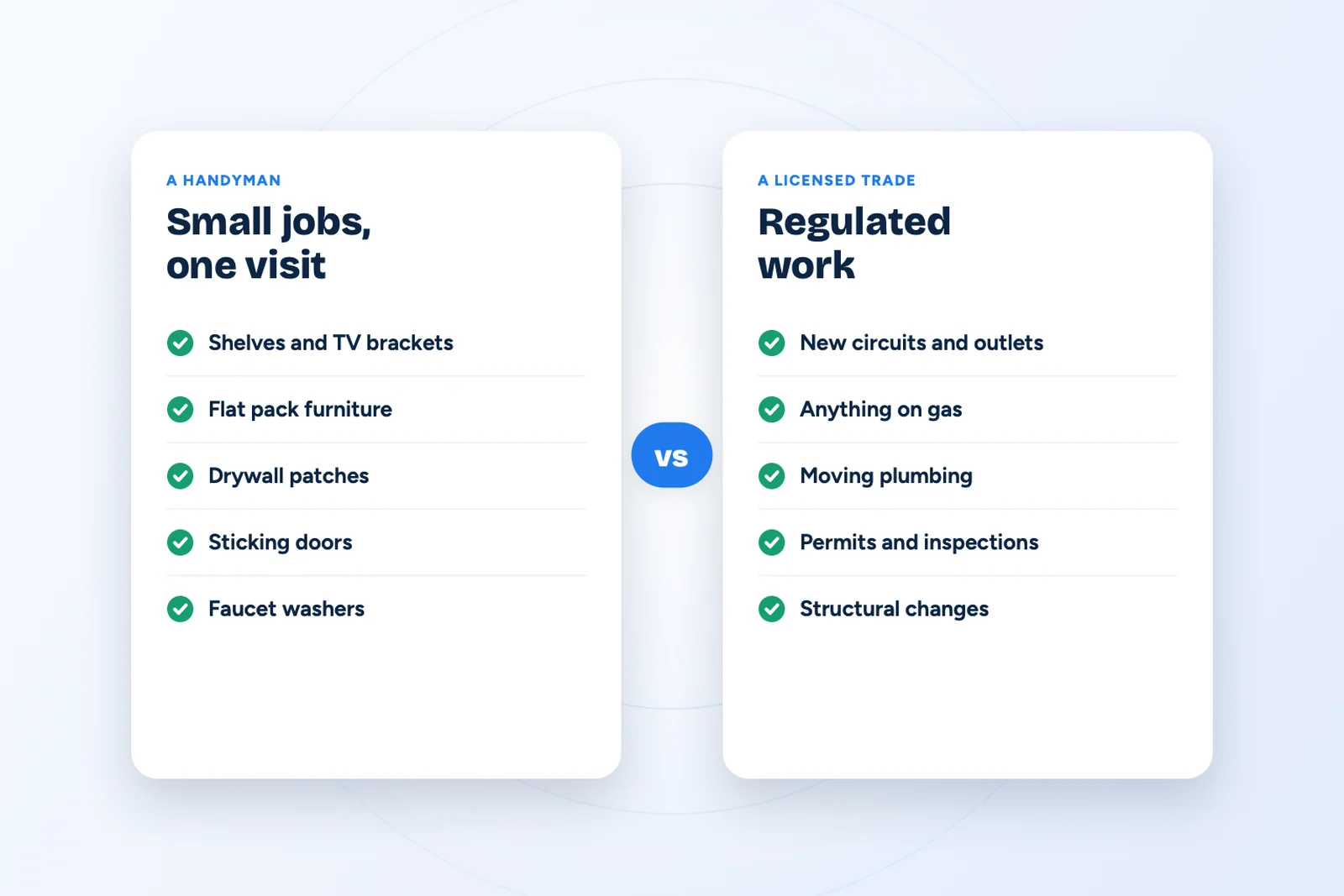
A handyman is a generalist who takes on small repairs and improvements that need skill but no license: patching drywall, hanging doors and shelves, assembling furniture, fixing a running toilet, replacing a faucet washer, sealing a bath, touching up paint, clearing gutters. The value is breadth. One visit can clear a list that would otherwise need five different trades and five call-out fees.
A good handyman also knows where their work stops. For a sense of the usual range, see what handymen usually cover.
What a contractor does
"Contractor" covers two kinds of business. A licensed trade, such as an electrician, plumber or gasfitter, does one kind of regulated work and holds the license for it. A general contractor or builder runs a project, coordinates the trades, orders materials, deals with permits and inspections, and takes responsibility for the whole job.
You need the first for anything regulated, however small, and the second when a project involves several trades in sequence, such as a kitchen or bathroom remodel, an extension, or structural work.
Handyman vs contractor: where the law draws the line
The line is mostly drawn by the type of work, and in some places by its size. In much of the US, states set a dollar limit, counting labor and materials together, above which a contractor license is needed. California raised its limit to $1,000 in 2025, for example, and the exemption falls away if the job needs a permit. Other states have no general contractor license for small jobs at all and leave it to cities and counties.
Whatever the price, gas work and fixed electrical wiring are licensed or tightly controlled almost everywhere. Gas work needs a registered or licensed gasfitter in Canada, the UK, Ireland, Australia and New Zealand, and in most US states it goes to a licensed plumber or gas fitter. Electrical work on fixed wiring must be done by a licensed electrician in every Australian state and territory, and is closely controlled in the other countries. In New Zealand, plumbing and drainlaying are licensed too, and restricted building work must be done or supervised by a Licensed Building Practitioner.
If you are not sure which side of the line a job falls on, ask the regulator. When a job does need a license, check the license yourself on the official register.
Permits and inspections
A permit is a separate question from a license. Adding an electrical circuit, moving plumbing, changing structure, building a deck above a certain height, or replacing a water heater often needs permission from your local authority, and an inspection when the work is done. The rules are local and they change.
A handyman generally cannot take on permitted work, and should say so. A contractor pulls the permit, arranges the inspection, and hands you the paperwork. If anyone suggests skipping the permit to save money, decline: unpermitted work can void an insurance claim and come back to you when you sell.
How they price
Handymen usually charge by the hour with a minimum visit, by the half day or day, or a flat price per task. Their rates are generally lower than a licensed trade's, and the cheapest way to use one is to bring a long list and have the parts on site.
Licensed trades charge more per hour because of the license, the insurance, the training and the responsibility for regulated work, and often add a call-out fee. General contractors price the whole project and add a margin for coordinating it. That margin buys scheduling, supervision and one person accountable for the result, which is worth a lot on a job with five trades in it.
Insurance and warranties
Whoever you hire, ask for a certificate of liability insurance and read it: the business name, the type of cover, and the dates. A handyman's insurance matters as much as a contractor's, because a slipped drill or a flooded bathroom costs the same whoever caused it.
Ask about warranties too. Licensed trades and contractors usually warrant their labor for a period, and materials carry the manufacturer's warranty. For small handyman jobs, agree what happens if something fails in the first weeks, and get it in writing.
Splitting a project between them
Many jobs are cheapest done in two parts. A plumber connects the new vanity and the handyman hangs the mirror, the cabinet and the towel rails. An electrician runs the new circuit and the handyman patches and paints the wall afterwards. Pay the licensed rate for the regulated part and the handyman's rate for everything else.
The trick is sequencing. Agree who does what, in which order, and who is responsible for the finish where their work meets. On a bigger project, that coordination is exactly what a general contractor is for.
A quick guide for common jobs
Local rules decide the details, but for most homes the split looks like this:
- Hanging shelves, pictures, mirrors or a TV bracket: a handyman
- Assembling flat pack furniture: a handyman
- Patching drywall and touching up paint: a handyman
- Replacing a faucet washer or a toilet fill valve: usually a handyman
- Replacing a light fitting on an existing circuit: an electrician in many places, and always in Australia
- Adding an outlet or a circuit: an electrician, usually with a permit
- Anything connected to gas: a licensed or registered gasfitter
- A kitchen or bathroom remodel: a general contractor, with licensed trades for the plumbing, gas and electrics
When a job sits near the line, the honest answer from a handyman is "that one needs a licensed trade". Treat that as a sign you found a good one.
Questions to ask either one
Whoever you call, the first questions are the same. Is this work you are allowed to do here, and do you need a license or a permit for it? Have you done this exact job recently, and can you show me? What does your price include, and is it fixed? Are you insured, and can you send the certificate? What warranty do you give on the work? The answers tell you quickly whether you have called the right kind of help.
Which one to call
Call a handyman for small, unlicensed jobs, especially when you can group several into one visit. Call a licensed trade for anything involving gas, fixed wiring, or regulated plumbing, however small. Call a general contractor when a project needs permits, structural work, or several trades in sequence.
If the list is mostly small jobs, start with how to hire a handyman, and take the regulated items off it before anyone arrives.
Need this done?
Describe the job once and contractors near you get in touch. It costs you nothing.