Handyman Services List: What a Handyman Can Do
Handyman services list: the jobs a handyman can do inside and out, the ones that need a licensed trade, how visits are priced, and how to plan one.

Every home keeps a quiet list. The door that drags, the blind that hangs at an angle, the tile that lifted, the smoke alarm chirping somewhere. None of it is urgent, which is exactly why it survives for years. Local handyman services exist for that list, and a good handyman services list is mostly knowing what belongs on it and what does not.
This is a guide to scope rather than to hiring: what a handyman can do, what has to go to a licensed trade instead, how a visit is priced, and how to build a list that is worth somebody's morning. If you want the hiring steps themselves, they are in how to hire a handyman, and for the licensed trades in our step-by-step guide to hiring a contractor.
A handyman services list: what they cover
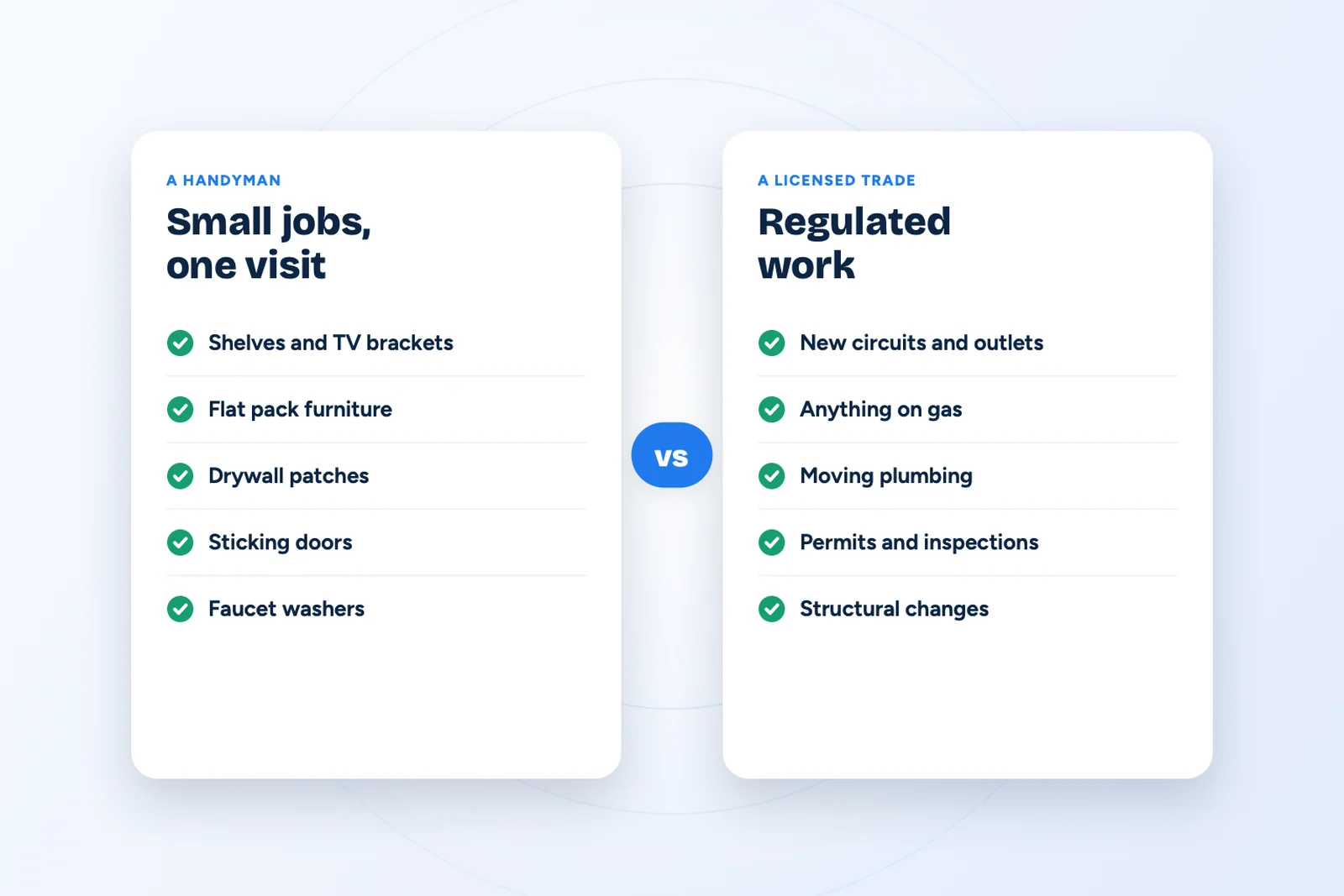
Inside, the usual work is doors and windows that stick, locks and handles, shelves, blinds and curtain rails, televisions and mirrors on walls, drywall patching and touch up paint, flat pack assembly, grout and sealant, running toilets, dripping faucets, sticking drawers, loose stair rails and smoke alarm batteries.
Outside, it is gutters, downspouts, fence panels and gates, deck boards, weatherstripping, exterior caulking, hose bibs, mailboxes, house numbers, pressure washing, screens and storm doors, and the small carpentry nobody else wants to quote for.
The common thread is scale. These are jobs measured in hours, done by one person, with hand tools and a small amount of material. When a job needs a permit, a crew, or a trade license, it has left handyman territory.
The other thing they bring is judgment about houses. Somebody who works on them all week will tell you when a sticking door is a hinge and when it is a frame moving because a gutter has been spilling into the wall for two winters.
The jobs that need a licensed trade instead
New electrical circuits, panel work and anything that needs an inspection belong to an electrician. Gas appliances and gas lines belong to somebody licensed for gas. Moving walls, altering framing, roofing and anything structural belongs to a contractor with the right license and usually a permit. If you are unsure, see whether you need a handyman or contractor.
Most US states also set a dollar limit for work that can be done without a contractor license, counting labor and materials together, and the limits differ a lot from state to state. A handyman who knows the local limit and says a job is over it is doing you a favor. In Canada, the UK, Ireland, Australia and New Zealand the limits are drawn by trade rather than by price: gas and electrical work need the licensed or registered trade, whatever the job costs.
Plumbing and HVAC sit on the line. Replacing a washer, a trap or a faucet is ordinary handyman work in most places. Opening up a wall, moving a waste line, or touching a system with refrigerant in it is not.
How local handyman services charge
Three structures cover nearly everything. Hourly with a minimum of one or two hours suits a mixed list. A half day or full day rate suits a long list and is usually the best value per job. A flat price per task suits work that is easy to picture, like mounting a television.
On top of that sit the extras: a trip or call out fee, materials with or without a markup, disposal of whatever comes off your house, and higher rates for evenings and weekends. Ask which of those apply before the visit rather than at the end of it.
Because most of the pricing is about time, the cheapest way to use a handyman is to have the list ready and the parts on site. Half an hour of somebody driving to a hardware store is charged at the same rate as half an hour of fixing your door.
Ask how they handle a job that turns out bigger than it looked. The answer you want is that they stop, explain it, and price it before carrying on, rather than working through lunch and presenting you with the total afterwards.
Build a list worth one visit
Keep a running note on your phone, and add to it whenever something annoys you. When the list reaches six or eight items, book a half day rather than calling about one thing.
Then do the preparation that makes the visit fast:
- Photograph each job, and measure anything that needs a part
- Note the make and model of fixtures, faucets and appliances
- Buy the specific parts you want fitted, or agree who is buying them
- Clear access to every work area, including the attic hatch and the crawl space
- Decide the things you would want decided, such as shelf heights and television positions
- Flag anything you suspect is a licensed job, so it can be quoted properly instead of started
Order the list by what matters most to you. If the day runs short, you want the sticking front door done and the picture rail left for next time, not the other way round.
If there is new furniture waiting in boxes, add it to the same visit. Assembly is ordinary handyman work, and building it at home goes faster with somebody who is already there with a drill and a level.
A seasonal list for a house
Spring is gutters and downspouts, exterior caulk, screens back in, decks checked for lifted boards and popped nails, and hose bibs tested after the freeze. Summer is fences and gates, exterior paint touch ups, deck sealing and shade hardware.
Fall is the big one: gutters again after the leaves, weatherstripping and door sweeps, attic hatch seals, storm doors, outdoor faucets shut off and drained, and the chimney inspected by a sweep before the first fire. Winter is draughts, condensation, sticking doors, and the annual round of smoke and carbon monoxide alarm batteries.
Two visits a year, spring and fall, with a proper list for each, will keep an average house ahead of its own decay. It is also much cheaper than the repairs that arrive when small things are left.
For landlords and small businesses
Turnarounds between tenants are exactly this kind of work: patch, touch up, re-key, re-hang, replace, and a punch list signed off in one visit. Having one person who knows the building is worth more than the few dollars saved by rebidding every job.
Agree the practical things up front: how access works, who holds keys, what can be done without checking with you, and what must be approved first. Ask for an invoice per property rather than a lump sum, so repairs are recorded against the right unit for your own accounts and for any deposit statement. In the United States you will also need a W-9 from a contractor you pay regularly, so ask for it at the start rather than in January.
Finding someone good nearby
Local matters more here than in most trades. A handyman who works two towns away charges for the travel one way or another, and the value of a good one is that they can come back on Thursday for the thing that turned out to need a part.
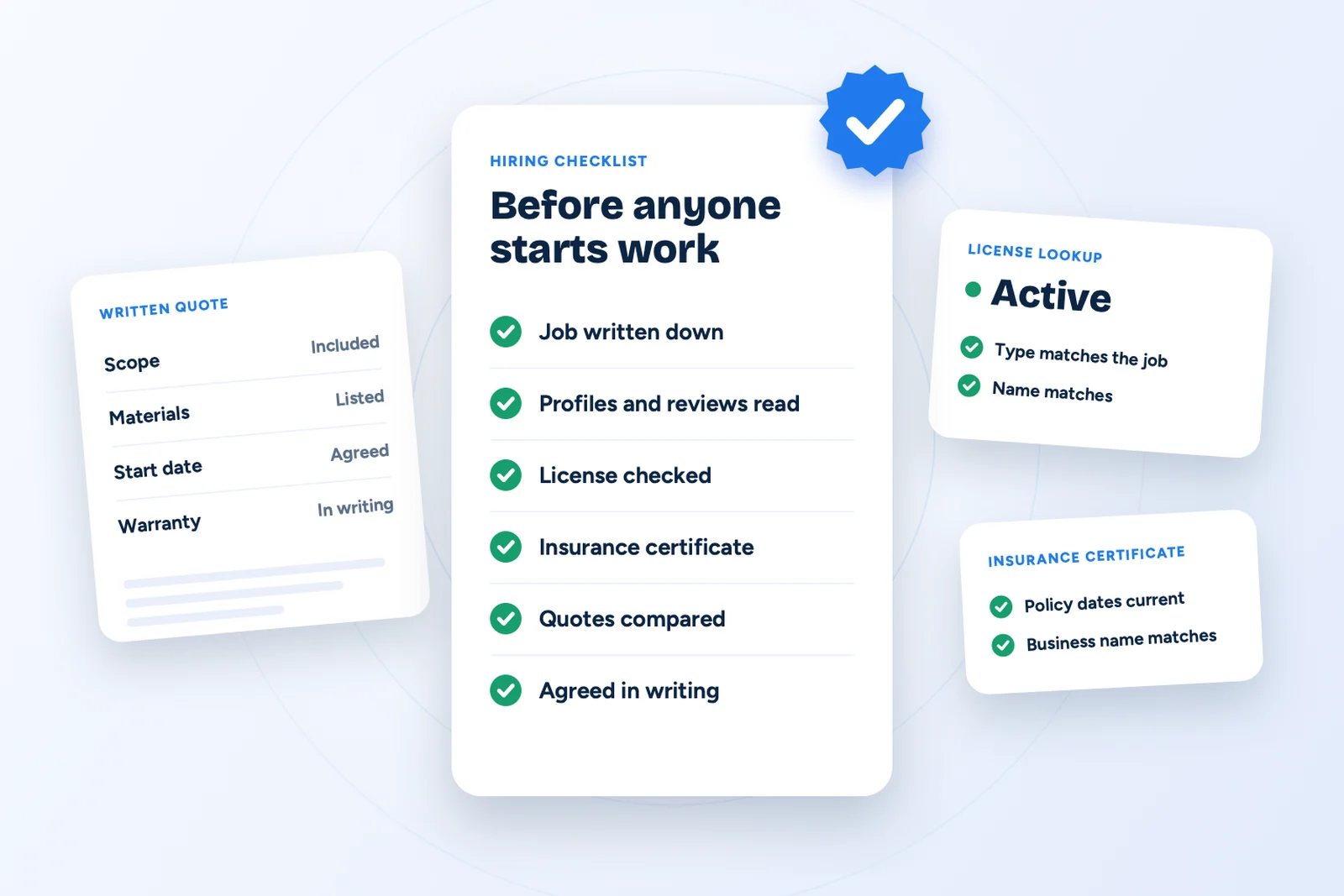
Check the service area on the profile, read reviews that describe work like yours, and look at photographs of finished jobs. If the work needs a license, check it on the official register, your state board's site in the US, rather than taking a badge's word for it. To have people come to you instead, post the job with your list and your city, and compare what comes back.
Getting the most out of the visit
Be there at the start, walk the list together, and agree what is realistic in the time booked. If you want to add something once they are in the house, ask what it will cost first. Mid visit additions are how a half day becomes a full one without anybody meaning it to.
At the end, ask what they noticed but did not touch. A handyman who has spent four hours in your home has seen the rot at the bottom of a door frame and the shower seal that is about to fail. That answer is free, it belongs at the top of next season's list, and it is usually the difference between a small repair and a big one.
Need this done?
Describe the job once and contractors near you get in touch. It costs you nothing.